

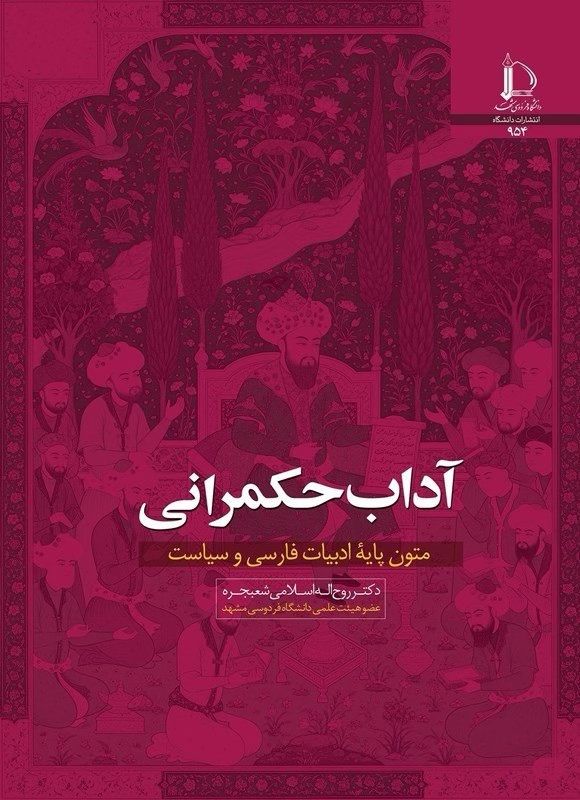
On the Book The Ethics of Governance: Foundational Texts of Persian Literature and Politics
In The Ethics of Governance: Foundational Texts of Persian Literature and Politics, Ruhollah Eslami presents an analytical and interdisciplinary study that rereads the heritage of Persian literature as a foundation of the Iranian humanities. The author argues that “the humanities in Iran are Persian literature” and maintains that the roots of political thought, the ethics of power, and approaches to just governance should be sought in the historical layers of the Persian language and literary tradition.
The book represents a return to Iran’s intellectual heritage from antiquity to the contemporary era—a heritage shaped by the interrelationship of politics, ethics, wisdom, and literature, and preserved in enduring texts ranging from works of wisdom and counsel to writings from the Constitutional period.
In the introduction, the author emphasizes the importance of the “continuity of the Iranian rational tradition,” a continuity that, in Persian literature, has not merely been narrated but institutionalized. In Eslami’s view, Persian literature embodies a language of tolerance, avoidance of harming others, and an invitation to rational thought—a language that restrains power and reinforces ethics. Accordingly, understanding the traditions of statecraft and the logic of government in Iran is impossible without examining its literary texts, since literature has historically served a political and social function in Iran. Mirrors for princes, historical chronicles, and ethical treatises have been among the principal foundations of the Iranian conception of governance.
The book is organized into several chapters, each devoted to major thinkers and foundational literary-political works in Iran. The first chapter introduces the principles of governance in classical Persian literature. By examining texts such as Minui Khirad, ancient advice literature, and the tradition of Nasihat al-Muluk (Counsel for Kings), the author demonstrates how state formation in Iran was grounded in the ethics of power, experiential wisdom, and spiritual order.
The following chapter examines the works of Khwaja Nizam al-Mulk Tusi and his role in the institutional development of the Seljuk state. Eslami considers Nizam al-Mulk’s Siyasatnama (The Book of Government) one of the early classical texts on public administration, in which security, justice, and the organization of the bureaucracy are defined as fundamental principles of governance.
The third chapter focuses on Ala al-Din Ata-Malik Juvayni and his important work, Tarikh-i Jahan-Gusha (The History of the World-Conqueror). The author describes the work as a reflection of Iranian political thought in confronting the crisis caused by the Mongol invasion. The chapter demonstrates how Juvayni’s historiography combines politics, ethics, realism, and historical wisdom.
The fourth chapter is devoted to the Qabusnama and the tradition of writing books of advice. The work addresses political education, the ethics of power, practical wisdom, and the principles of governance in connection with everyday life.
The next chapter examines Ubayd Zakani and his Akhlaq al-Ashraf (The Ethics of the Nobility). Through his sharp satire, Ubayd criticizes political corruption, elite hypocrisy, and the inversion of the moral foundations of power. Eslami shows how Ubayd, through satire and ambiguity, produced one of the most serious critiques of those who exercised power in Iranian history, a critique that the author considers relevant to the analysis of contemporary governance.
The book then turns to the treatises and writings of the Constitutional period, examining the role of thinkers of that era in transforming traditional political ethics into a theory of the modern state. During this period, concepts such as law, freedom, public participation, and the rule of law entered Persian political writing, giving the ethics and practices of governance a new meaning and structure.
Throughout the book, Ruhollah Eslami argues that Iranian intellectual currents, from antiquity to the Constitutional period, consistently confronted various forms of anti-Iranian sentiment and sought, through literature, to restrain power and reconstruct the principles of governance.
He emphasizes that Persian literature is not merely an art form but a “living political tradition” that has shaped the logic of Iranian governance. From the author’s perspective, returning to this intellectual heritage is essential for understanding contemporary governance, since many of the present-day crises of politics and government in Iran stem from a rupture with this tradition and the neglect of classical political literature.
The Ethics of Governance is an analytical and critical work grounded in textual studies. It is particularly relevant to researchers in political science, Persian literature, historical sociology, and those interested in the development of Iranian political thought.
Written in an accessible yet research-based style, the author builds a bridge between literature and politics and demonstrates how texts such as Minui Khirad, The Testament of Ardashir, Nizam al-Mulk’s Siyasatnama, Juvayni’s Tarikh-i Jahan-Gusha, the Qabusnama, Akhlaq al-Ashraf, and the political writings of the Constitutional period contributed to what the author describes as the hard core of Iranian political thought.
The book was published by the Scientific Works Publishing Group. Its author is Dr. Ruhollah Eslami Shabjareh. The first edition was published in autumn 1404 (2025) and consists of 200 pages.
Further information about the book and related publications is available through the publishing portal of Ferdowsi University of Mashhad at press.um.ac.ir
Page Term Reference
Comments